|
|
MODERN DAY SIGHTINGS OF STRANGE FLYING CREATURES!
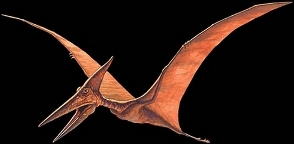
A gigantic bird-like creature was reported as
sighted in Pennsylvania. On the evening of Tuesday, September 25, 2001.
A 19-year-old claimed to have seen an enormous winged creature flying over
Route 119 in South Greensburg, Pennsylvania. The witness's attention was
drawn to the sky by a sound that resembled "flags flapping in a
thunderstorm." Looking up, the witness saw what appeared to be a bird that
had a wingspan of an estimated 10 to 15 feet and a head about three feet
long.
This
is the most recent sighting of an incredible creature - most often
considered a myth - known as a "Thunderbird." Sightings of these gigantic
birds, apparently unknown to science, go back hundreds of years and are a
part of many Native American legends and traditions. They have even been
blamed for abducting, or attempting to abduct, small children. And now,
according to various reports, they appear to be
soaring through the skies of
Pennsylvania.
On
September 25, the witness told researcher Dennis Smeltzer, that the huge
black or grayish-brown bird passed overhead at about 50 to 60 feet. "I
wouldn't say it was flapping its wings gracefully," the witness told
Smeltzer, "but almost horrifically flapping its wings very slowly, then
glided above the passing big rig trucks."
The
witness observed the creature for about 90 seconds in total, even seeing it
land on the branches of a dead tree, which nearly broke under its great
weight. Unfortunately, no other witnesses saw the bird on this date and no
tangible evidence could be found for the bird after the site was searched.
What
makes this story more interesting, however - even plausible - is that other
sightings of similar description were reported in Pennsylvania in June and
July, 2001.
On
June 13, a resident of Greenville, Pa. was startled by the great size of the
grayish-black creature seen soaring overhead, at first thinking it was a
small airplane or ultralight aircraft! This witness observed the bird for at
least 20 minutes, clearly seeing its fully feathered body and confidently
estimating its wingspan to be about 15 feet and its body length at about 5
feet. This bird, too, was seen to perch on a tree for at least 15 minutes
before taking to air again and flying off toward the south. A neighbor of
this witness claimed to have seen the creature the next day, describing it
as "the biggest bird I ever saw."
Less than a month later, on July 6, a witness in
Erie County, Pa. reported a very similar sighting, according to an item in
Fortean Times
magazine. Again, the creature's wingspan was estimated to be 15 to 17 feet
and was described as "dark gray with little or no neck, and a circle of
black under its head. Its beak was very thin and long - about a foot in
length."
These
were not the first sightings of Thunderbirds in Pennsylvania, as you'll read
later in this article. And if these reports are accurate, these birds are
the largest flying creatures not yet identified by science. By comparison,
the largest known bird is the wandering albatross with a wingspan of up to
12 feet. The largest predatory birds - which the Thunderbird is most often
likened to - are the Andean condor (10.5-foot wingspan) and the California
condor (10-foot wingspan).
Centuries-Old Legend
The
legend of the Thunderbird reaches back hundreds of years as part of the
mythology of several Native American tribes of the Pacific Northwest and the
Great Lakes region. And the legend might have remained strictly a part of
those cultures had not the great winged creature been seen countless times
by the "white man" over the centuries.

Pictured above is a fascinating petroglyph (carved rock art) of what we call
a Thunderbird but note the details and similarities to what we now believe a
pterosaur looked like!
They
were the largest creatures to ever attain flight. With wingspans reaching
nearly 40 feet, pterosaurs supposedly ruled the prehistoric skies for over
100 million years, until they died out with the dinosaurs about 65 million
years ago.
Did
they really live 100 million years ago?
Is it
possible some of them still exist today?
There
have been many modern-day sightings of creatures that by eyewitness
description sound like pterosaurs. There are also intriguing rock carvings
and even photographs that suggest that this species of amazing flying
monsters could have survived extinction, could have soared through the skies
of the southwestern United States until very recently, and might still exist
in small numbers in remote parts of the world.
Pterosaurs were not dinosaurs, but a family of large flying reptiles
("pterosaur" means "winged lizard") that includes the pterodactyl and
pteranodon. The pterosaur stood on two rather spindly legs and had wings
composed of a leathery membrane that stretched from the animal's extremely
long fourth finger to its body. Despite their appearance, they were not
related to birds (as dinosaurs are theorized to be), and were highly
successful flyers that might have dined on fish and insects.
More Modern Sightings
Numerous photos were supposedly taken during the time of the Civil War . . . are these picture for real or altered? The pictures are very interesting, but remember, they may not be the best "evidence" of anything!
Although there seems to be no hard evidence that pterosaurs did not die out
millions of years ago - no pterosaurs have ever been captured and no bodies
have ever been found - sightings have persisted. Stories of flying reptiles
have been recorded for many hundreds of years. Some think that tales of the
"mythical" dragons in the lore of many cultures around the could be
attributed to the sighting of pterosaurs. Here are some more modern
accounts:
May,
1961, New York State - A businessman flying his private plane over the
Hudson River Valley claimed that he was "buzzed" by a large flying creature
that he said "looked more like a pterodactyl out of the prehistoric ages."
Early
1960s, California - A couple driving through Trinity National Forest
reported seeing the silhouette of a giant "bird" that they estimated to have
a wingspan of 14 feet. They later described it as resembling a pterodactyl.
January, 1976, Harlingen, Texas - Jackie Davis (14) and Tracey Lawson (11)
reported seeing a "bird" on the ground that stood five feet tall, was dark
in color with a bald head and a face like a gorilla's with a sharp,
six-inch-long beak. A subsequent investigation by their parents uncovered
tracks that had three toes and were eight inches across.
February, 1976, San Antonio, Texas - Three elementary school teachers saw
what they described as a pterodactyl swooping low over their cars as they
drove. They said its wingspan was between 15 to 20 feet. One of the teachers
commented that it glided through the air on huge, bony wings - like a bat's.
September, 1982, Los Fresnos, Texas - An ambulance driver named James
Thompson was stopped while driving on Highway 100 by his sighting of a
"large birdlike object" flying low over the area. He described it as black
or grayish with a rough texture, but no feathers. It had a five- to six-foot
wingspan, a hump on the back of its head, and almost no neck at all. After
consulting some books to identify the creature, he decided it most looked
like a pterosaur.
Africa's Kongamato
While
other reports of pterosaur-like creatures have come out of Arizona, Mexico
and Crete, it is out of central Africa that some of the most interesting
anecdotes have come. While traveling though Zambia in 1923, Frank H. Melland
collected reports from natives of an aggressive flying reptile they called
kongamoto,
which means "overwhelmer of boats." The natives, who were occasionally
tormented by these creatures, described them as being featherless with
smooth skin, having a beak full of teeth and a wingspan of between four and
seven feet. When shown illustrations of pterosaurs, Melland reported, "every
native present immediately and unhesitatingly picked out and identified it
as a kongamato."
In
1925, a native man was allegedly attacked by a creature that he identified
as a pterosaur. This occurred near a swamp in Rhodesia (now Zambia) where
the man suffered a large wound in his chest that he said was caused by the
monster's long beak.
In the
late 1980s, noted cryptozoologist Roy Mackal led an expedition into Namibia
from which he had heard reports of a prehistoric-looking creature with a
wingspan of up to 30 feet.
If pterosaurs really died out with the dinosaurs and
their fossil remains were not first discovered until 1784 (in Germany), then
a depiction of one could not possibly exist in an ancient rock carving. Yet
a pictograph found high on a cliff face near Thompson, Utah seems to show
just that.
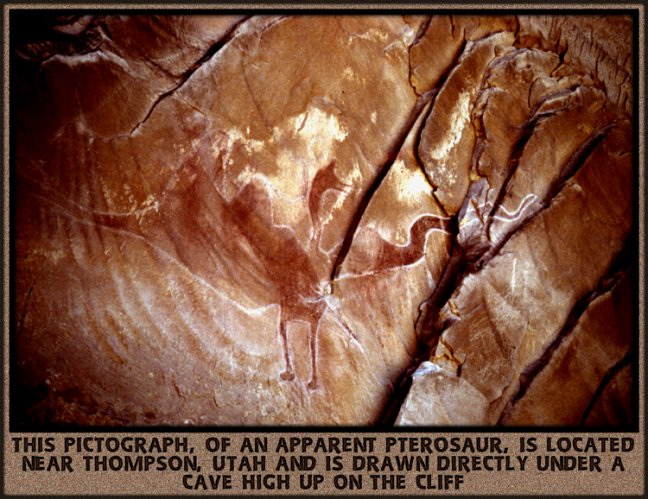
While
many experts believe the drawing is of a bird, the beak, head prominence,
wings and legs also look very much like those of a pterosaur.
Another fascinating tale of a pterosaur
literally
coming out of stone dates back to 1856 in France. Workmen were digging
through Jurassic-era limestone for a railway tunnel between the St.-Dizier
and Nancy lines. When a large bolder of limestone was split open, the
workers were astonished to see a large winged creature come stumbling out.
They said it fluttered its wings, let out a croaking noise and then dropped
dead at their feet. The creature had thick black, leathery skin, a beak full
of sharp teeth, long talons for feet, and membrane-like wings that spanned
10 feet, 7 inches, by their measure.
The
body of the creature was taken to the nearby town of Gray, according to the
story, where it was identified as a pterodactyl by a student of
paleontology.
(REPORT gleaned from articles of Paranormal Phenomena.)
HISTORICAL SIGHTINGS:
Such
reports should not surprise us as several ancient historians reported that
they had seen flying reptiles. For some strange reason we are more
prone to listen to the testimony of ancient historians than we are to give
credence to the reports of our peers. Perhaps we are skeptical because
there are so many pranksters amongst us.
 HERODOTUS:
The will-known and respected Greek explorer, Herodotus, describe small
flying reptiles in ancient Egypt and Arabia. Herodotus reported that
the creatures had a snake-like body and bat-like wings. He recorded
that he saw a canyon with many piles of their backbones and ribs. He
also wrote that the strange creatures could sometimes be found in the spice
groves, and that when workers wanted to gather frankincense they would have
to make fires with odorous smoke to drive the pesky reptiles away.

CLICK HERE to return to the DINOSAUR INDEX
Aol users must request information by using the following email:
OTHER INDEX FILES:














©2006 Discovery News
There are numerous reports of modern-day sightings of strange flying creatures that resemble the flying reptiles known as pterosaurs. These reports are substantiated by the reports of ancient historians like Aristotle and Herodotus who claimed to have seen flying reptiles in their days!