SHIP ROCK
A Look at the Inside of a Volcano!
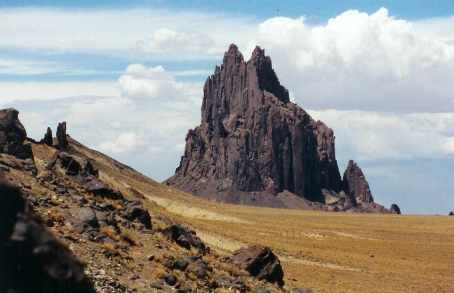
Like a gigantic ship at sea, Ship Rock is truly one of the wonders of the world! You can see this amazing rock formation in northwestern New Mexico, just about 50 miles south of Cortez, Colorado.

Ship Rock, New Mexico is the remnant of a gigantic "volcanic plug" from a by-gone volcano in the Navajo Volcanic Field of northern New Mexico.
The remarkable thing about Ship Rock is that it is not made of sand stone like so many of the other beautiful monuments in the area. Ship Rock is composed of fractured volcanic rock called "minette". The black formation juts up 1,583 feet above the surrounding high-desert plain.
Wikipedia, the on-line encyclopedia reports that scientists believe that Ship Rock was once a "volcanic plug" formed when magma or molten rock hardened in the vent of an active volcano. Similar rock formations that were once active volcanoes can be seen in Australia, Saint Lucia, Scotland and Italy. Other well known "volcanic plugs" in the United States include Devils Tower in Wyoming, Morro Rock in California and Lizard Head in Colorado.
When I visited the site years ago, I thought it was a rock formation that had been thrust up out of the desert sands. I was wrong. Ship Rock is the interior rock of a volcano, the outsides of which were miraculously eroded away to leave a huge monument visible for over 100 miles on a clear day.
If this huge rock formation was once a hardened magma plug on the inside of a volcano, we have to ask the question: "What happened to the actual volcano dome or the outside of the volcano?" "Where is the rest of the ancient volcano?"
Some scientists tell us that the exterior of the volcano eroded away over the course of millions and millions of years. Other scientists have a different and more logical explanation as illustrated to the right.
Evolutionary scientists claim that the Ship Rock volcano erupted millions and millions of years ago and that it took 20 to 30 million years for the outer core of the volcano to slowly erode away. Evidence throughout the desert southwest, however, confirms that a massive flood eroded huge amounts of soft mud deposits in an amazing short period of time.
CLICK HERE for revealing information about the formation of the Grand Canyon.

Lava Rocks from volcanic eruptions are found in the San Juan and Colorado River drainages. These rocks were moved by the powerful action of flood waters. Some of them probably originated at the Ship Rock volcano in northwestern New Mexico.

The picture above reveals several large wall-like sheets of "minette" (hardened magma or volcanic rock) that protrude up from the desert floor and radiate away from the central "volcanic plug" formation. These "dykes" as they are called, are visible for miles on the southern and western sides of the Ship Rock formation.
This would illustrate catastrophic events that occurred as the earths foundation or bedrock was cracked, possibly at the time that the Rocky Mountains were thrust up and the valleys of the oceans were formed.

Million upon millions of years were not required to erode away the soils surrounding the "dykes" and "volcano plugs" . . . In fact, if the world was 20 to 30 million years old, the size of the sun would have been so much larger that life on earth could not have survived and there certainly would not have been dinosaurs wandering around as the evolutionary time-table suggests!
We need to re-think the unfounded claims of evolutionary philosophers who blatantly refuse to believe in a universal flood or the God Who created all things.
The Bible declares -- "For this they willingly are ignorant of, that by the word of God the heavens were of old, and the earth standing out of water and in the water, By which the world that then was, being overflowed with water, perished." 2 Peter 3:5-6
Aol users must request information by using the following email:

OTHER INDEX FILES:














The magnificent Ship Rock formation located in northwestern New Mexico is not made of sand stone like so many of the other beautiful monuments in the area. Ship Rock is composed of fractured volcanic rock called "minette". The black magma formation juts up 1,583 feet above the surrounding high-desert plain and scientists tell us that it was the inner core or "volcanic plug" of a once active volcano which has now eroded away. This massive erosion is another evidence for an incredibly large flood.