WELCOME TO THE PLANET & MOONS DISPLAY!
Did you know that the planet Jupiter has 63 confirmed moons?
 In 1610, the
well-known astronomer Galileo discovered four of the moons in his
telescope. They are called the "Galilean Moons" named after
Galileo.
Saturn also has a number of moons -- 60 of them in all!
Wouldn't it be awesome to look up into the night sky and see 60 moons orbiting our earth?
But there is an important lesson to learn from all those moons on Jupiter and Saturn: they are not all orbiting in the same direction!
One third of their primary moons have retrograde (backward) motion, opposite to the rotational direction of their planets.
This casts some serious doubt on the feasibility of the "Big Bang" theory of the beginning of the universe because everything should be spinning and orbiting in the same direction!
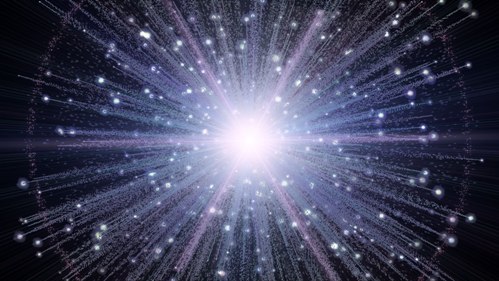 In
1948, according to an astronomer (and science fiction writer) by the name of
George Gamow, "an explosion of nothing produced hydrogen
and helium, which then shot outward, then turned and began circling
and pushing itself into our present highly organized stars and
galactic systems."
Did the universe really begin with nothing exploded and formed all the galaxies?
 Both Uranus and
Venus rotate backward, compared to the other planets orbiting our
sun. The
other seven planets rotate forward in relation to their orbit
respective orbits. This could not have happened if it all
began with a BIG BANG!
CLICK HERE to return to the SPACE INDEX
Aol users must request information by using the following email:

OTHER INDEX FILES:










"The universe has a wonderful story to proclaim. You will find clues about how it all began and when. Surprising discoveries about the planets and their moons are proof that the universe could not have been started with a BIG BANG!
©2006 Discovery News / Biblical Archeology / Noah's Ark / Chariot Wheels in the Red Sea / Dinosaurs / Ooparts or Out of Place Artifacts / Biblical Prophecy / Creation Science / Evolution / Fossils / Native American Rock Art / Discoveries confirm the accuracy of the Bible.